Dominick Birdsey
I Know This Much Is TrueDominick Birdsey is the novel’s first-person narrator and the surviving identical twin of Thomas Birdsey. His defining conflict is that love and resentment coexist: he has spent much of his life protecting Thomas, yet experiences that responsibility as a weight that threatens to consume his own life. Thomas’s death makes Dominick confront not only the limits of his power to save his brother, but also the guilt attached to the times he withdrew, failed to act, or wanted escape. His later life depends on learning to grieve Thomas without treating his own survival as a betrayal.
Identity and Narrative Perspective
Dominick recounts events from a deeply involved, retrospective point of view. The story reaches readers through his account of family life, childhood memories, relationships, and the decisions surrounding Thomas’s care. His perspective is not emotionally detached: he repeatedly interprets events through the question of what he did or failed to do for his brother. That inward pressure gives his narration its characteristic tension. Dominick is both witness to Thomas’s history and a participant who fears that his own conduct helped shape it.
The twins are identical, not fraternal. Dominick recalls their likeness as something more consequential than resemblance: other people can look at him and see Thomas, and he understands their shared identity as making each brother difficult to distinguish from the other. A childhood newspaper photograph preserves them as newborns curled toward one another. The image offers an early version of the bond that governs Dominick’s adult life: closeness that is also a problem of separation, as if each brother’s identity were partly held in the other.
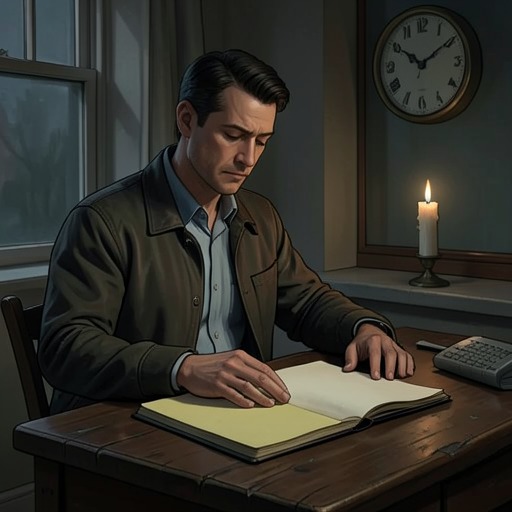
On October 12, 1990, Thomas enters the Three Rivers Public Library and retreats to a rear study carrel, praying that the sacrifice he is about to make will be acceptable. The head librarian is away at a meeting in Hartford, leaving Theresa Fenneck officially in charge. Dominick’s recollection of this day places a private religious purpose inside an ordinary public setting. The scene also exemplifies his narrative position: he tells the story as Thomas’s brother, but cannot make Thomas’s intentions or fate wholly his to control.
Childhood and the Burden of Protection
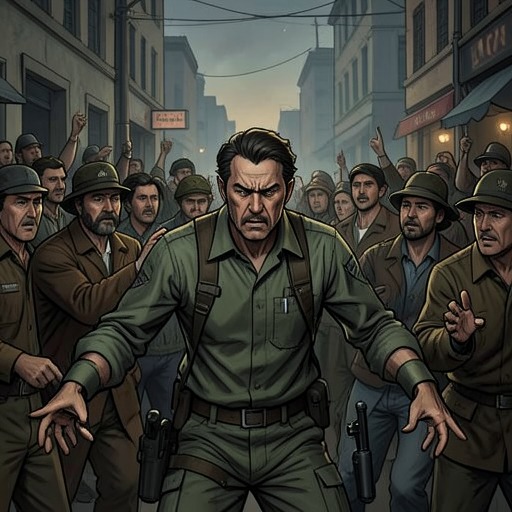
As a child, Dominick imagines a rescuing father arriving by airplane to take him, Thomas, and Ma away and punish Ray for bullying them. He later abandons this fantasy of rescue and begins to provoke Ray himself in small, calculated ways. Still afraid of Ray’s anger, he learns to conceal fear and meet the older man’s gaze. Dominick describes this adaptation as self-preservation, but it has a cost: he also makes a point of showing Ray that Thomas is the weaker twin. His impulse to protect his brother therefore grows alongside behavior that exposes Thomas to humiliation.
That contradiction carries into adulthood. When Thomas promises to keep up with his assignments, take walks when nervous, and study at the library with Dominick, Dominick silently decides that Thomas must succeed or fail without his help. He will not guide him to the library or cover for him when he takes his frustration out on their typewriter. The decision is an attempt to stop managing Thomas’s life, but it is also a withdrawal from the role Dominick has long treated as his own. Later, when Thomas’s difficulties deepen, the boundary between necessary independence and abandonment becomes one of Dominick’s central sources of guilt.
At the University of Connecticut, the brothers’ shared room becomes another site of conflict. Dominick recalls Thomas shutting himself away and taking his frustration out on their typewriter. When the time comes to choose a roommate, Dominick tells Ma and Thomas that he will room with Leo Blood instead. He has made the decision without Thomas’s agreement, and he cannot bring himself to look directly at his brother as he announces it. The choice is a concrete attempt to separate their lives, but its painful delivery shows how difficult Dominick finds even an ordinary act of independence.
Adult Relationships and Conflicted Loyalties
Dominick’s relationship with Thomas is not the only one organized around his sense of obligation. He remembers his friendship with Leo as a history containing genuine affection as well as serious mistakes. When Gene condemns Leo, Dominick resists the judgment, not because he denies Leo’s faults but because he knows the friendship cannot be reduced to them. His instinct to defend people he cares about appears again in his advocacy for Thomas: loyalty moves him to intervene, but can also make it hard for him to judge his own conduct clearly.
Dominick’s marriage to Dessa is marked by loss. Their daughter Angela dies in May 1983, three weeks and three days after her birth. Dominick is the one who finds her. He remains grateful that Dessa, who had been up with the baby during the night, was spared that discovery. He had stayed up late correcting his students’ papers, overslept after switching off his alarm, and was nearly out the door when he decided to return and kiss the baby. The account preserves the ordinary decisions around the loss without making them explain it; nevertheless, it becomes part of the grief Dominick carries into later relationships.
His separation from Dessa is accompanied by a painful recognition of his own behavior. Looking back on what he did to her in a parking lot, as well as what he and Leo did to Ralph Drinkwater, Dominick asks himself what kind of person he has been and whether his actions contributed to Thomas’s deterioration. When a conversation with Dessa brings up her reason for leaving—that she felt crowded out and needed room to breathe—Dominick accepts that her judgment may have been right. Her departure is thus not merely another loss in his life; it forces him to see how his consuming preoccupation with Thomas can injure the people around him.
Advocacy, Failure, and Thomas’s Death
Dominick repeatedly takes Thomas’s side in institutional settings. He distrusts the accounts provided by the people responsible for Thomas’s care and insists on obtaining an independent examination. His advocacy is forceful because he believes his brother cannot defend himself, and he fears that Thomas may have been sexually abused at the institution. Yet Dominick’s protectiveness can become overconfidence. He acknowledges that Thomas’s social worker and doctors advised him to proceed cautiously after Thomas’s release, but he believed he knew better. After Thomas dies, Dominick interprets that disregard as arrogance and imagines that a different choice might have kept his brother alive.
His efforts are also marked by an unmistakable failure of timing. Dominick realizes that he has not made it to Thomas’s hearing and believes he has let his brother down. When asked for the date, he recognizes how completely he has lost track of the proceeding; overwhelmed and helpless, he breaks down in tears. On April 11, 1991, the Psychiatric Security Review Board reverses its earlier decision and transfers Thomas to his family’s custody, effective immediately. The Board strongly recommends that Thomas be placed at once in a fully staffed, fully secured nonforensic psychiatric hospital. The decision gives Dominick the family custody he has fought for while making the need for continued professional care explicit.
In recounting the decision, Dominick admits that he dismissed warnings that Thomas would feel unprotected after six months in a highly secured institution. He presents his own certainty as a failure of judgment, not as proof that he cared too little. The distinction matters: his devotion is real, but devotion does not make him an expert on Thomas’s needs or give him control over the outcome. After Thomas drowns, Dominick says he will carry his brother for the rest of his life, bearing the weight of what he did and did not do. At a funeral, he identifies guilt as the source of his own and Ray’s tears, accusing them both of having bullied Thomas to death. The accusation shows how grief turns responsibility into a sweeping verdict against himself and his family.
Separation, Fatherhood, and Change
Dominick’s bond with Thomas is expressed through images of anchoring and entrapment. He describes his brother as an anchor that has pulled him down, leaving him only enough rope to reach the surface and breathe. The image gives shape to the resentment he has difficulty admitting: the relationship has felt life-sustaining and suffocating at once. In a morphine dream, Dominick imagines himself killing Thomas, taking him down from a tree, and carrying him toward a river. The dream does not establish a real act; it makes visible a wish and fear that Dominick cannot comfortably accommodate in his waking account of himself. His question about whether a person remains a twin after the other twin dies marks the identity crisis that follows Thomas’s death.
Lisa Sheffer helps Dominick distinguish mourning from self-erasure. She listens to his account of Thomas’s death and recognizes the complexity of his reactions, while insisting that her role is to support his life as the surviving twin, not to help him immobilize himself in grief. Dominick must acknowledge Thomas’s death while continuing to live his own life. That counsel challenges the belief that carrying Thomas means remaining trapped in the past or treating every future step as disloyalty.
Dominick’s understanding of fatherhood also changes. As a child and even as an adult, he invents possible fathers who might appear and rescue him from Ray. After speaking with Ray, he recognizes two distinct truths: his biological father died years earlier, while Ray, despite his parental shortcomings and the trauma he caused, was the male elder who remained present through Dominick’s passage into adulthood. Dominick’s realization does not erase the harm in their family history. It revises his understanding of what it means to have had a father, allowing presence and injury to remain part of the same relationship.
By the novel’s close, Dominick describes himself as a wealthy man, the father of a little girl, and once again the husband of Dessa. He recalls that, at forty-one, he lost his brother and found his fathers: the one who had died long before and the one who had been there all along. This ending does not undo Thomas’s death or resolve the guilt Dominick continues to carry. Instead, it gives that grief a place within a life that has gone on. Dominick’s survival becomes more than the residue of being the sane twin: it becomes a life with relationships and responsibilities beyond his effort to save Thomas.